It Isn’t…

A lot of people come into meditation carrying a bag full of symbols, rituals, spiritual accessories, and outward behaviors that they believe matter.
They may feel meaningful. Serious. Sacred.
But they do not create concentration.
They do not create stillness. Insight. Depth.
Again and again, people confuse the outer appearance of practice with the inner work of practice. They begin to believe that looking spiritual, sounding spiritual, or surrounding themselves with spiritual objects somehow moves the mind toward real stability and power.
It does not.
What matters is the training of attention.
What matters is letting go.
What matters is continuity of practice.
What matters is learning how to stay with the object without constant collapse into distraction, fantasy, memory, restlessness, and self-reference.
The rest is mostly decoration.
Here are 50 Meaningless Things People Often Attach To
- It isn’t your white clothes
- It isn’t your sandals
- It isn’t your bare feet
- It isn’t your Buddha amulet
- It isn’t your monk amulet
- It isn’t your sacred figure amulet
- It isn’t your mala beads
- It isn’t your incense
- It isn’t your candles
- It isn’t your altar
- It isn’t your singing bowl
- It isn’t your meditation shawl
- It isn’t your special cushion
- It isn’t your perfect posture photo
- It isn’t your retreat outfit
- It isn’t your temple bracelets
- It isn’t your spiritual necklace
- It isn’t your prayer flags
- It isn’t your crystals
- It isn’t your essential oils
- It isn’t your guru poster
- It isn’t your framed sacred quote
- It isn’t your low voice
- It isn’t your slow walk
- It isn’t your soft smile
- It isn’t your shaved head
- It isn’t your long hair
- It isn’t your tattoo of a lotus
- It isn’t your tattoo of a mantra
- It isn’t your Sanskrit shirt
- It isn’t your Pali words
- It isn’t your spiritual vocabulary
- It isn’t your chanting
- It isn’t your retreat selfies
- It isn’t your meditation room
- It isn’t your mountain view
- It isn’t your jungle hut
- It isn’t your temple setting
- It isn’t your beautiful silence around you
- It isn’t your group energy
- It isn’t your teacher sitting nearby
- It isn’t your monk blessing
- It isn’t your sacred book on the shelf
- It isn’t your collection of Dharma books
- It isn’t your knowledge of Buddhist history
- It isn’t your spiritual identity
- It isn’t your claim that you are advanced
- It isn’t your number of retreats
- It isn’t your meditation app streak
- It isn’t the image you have built of yourself as a meditator
None of those things can do the work for you.
None of them can hold attention steady for you.
None of them can let go for you.
None of them can walk through fear for you.
None of them can dissolve self for you.
None of them can build deep concentration in your mind.
They may decorate the path.
They may entertain the mind.
They may create mood.
They may signal identity.
They may make you feel like you belong to something.
But they are not the engine.
The engine is practice.
Steady, repeated, honest practice.
Returning to the object.
Letting distractions die.
Learning how to stop feeding thought.
Learning how to stop worshipping mood, symbolism, and atmosphere.
Learning how to sit without needing the performance of spirituality around you.
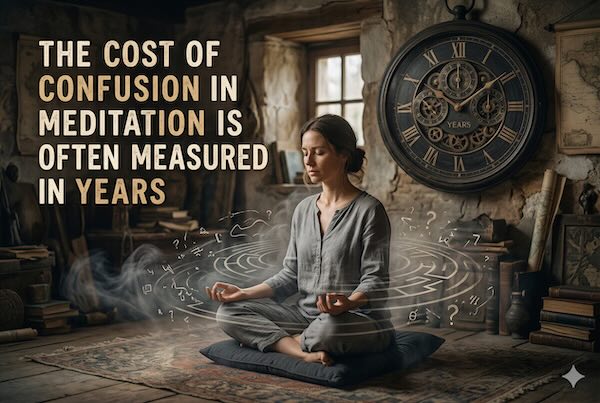
This is why some people spend years around meditation and never go very deep.
They become attached to the outer shell.
They protect the appearance of practice.
They collect the look, the language, the setting, the accessories, and the identity.
But the mind itself remains noisy, reactive, and weak.
Jhana does not care what you are wearing.
It does not care what is hanging around your neck.
It does not care how serene your room looks.
It does not care how many sacred objects are near you.
It does not care whether you look spiritual.
It responds to conditions in the mind.
That is where the real work is.
So if you are serious about meditation, especially serious about depth, stop overvaluing what merely looks meaningful.
Ask harder questions.
Can you stay with the object?
Can you let go of thought?
Can you remain steady?
Can you stop chasing stimulation?
Can you stop decorating the process and actually do the process?
That is where progress begins.
Not in the costume.
Not in the atmosphere.
Not in the symbols.
In the mind.
Always in the mind.