
The Cost of Confusion in Meditation is Often Measured in Years
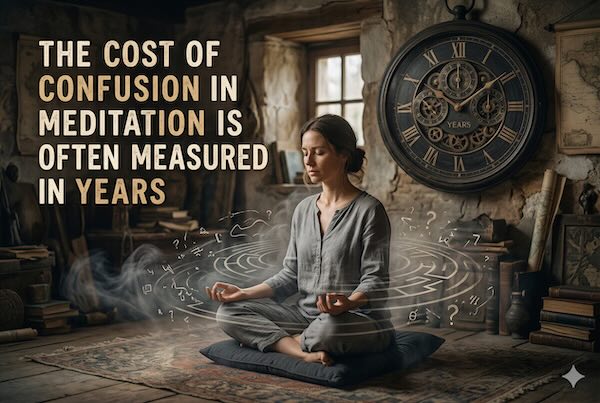
Sadly, my guess is that this is true for most people who begin a meditation practice.
The ideas are vague, the instructions are inconsistent, and much of what gets taught is repeated from books, a variety of traditions, or secondhand theories rather than from clear, direct experience.
So you sit.
You try.
You put in months. Sometimes years.
And still, you do not know what you are doing wrong.
People don’t know whether they are progressing. They don’t know what deep concentration actually feels like. They don’t know whether they should stay with the breath, widen awareness, relax more, apply more effort, or drop half of what they have been told because it is slowing them down.
That is the real cost of confusion in meditation.
It is not just that progress is slower.
It is that people can lose years moving in circles.
They keep practicing, but without enough clarity to tell the difference between real development and spiritual fog. They may build a habit, which is good. They may become a little calmer, which is also good. But most people never get anywhere near the deeper stages of collectedness, stability, and profound mental unification that made them interested in meditation in the first place.
This happens for a few reasons.
First, meditation is often taught in broad, fuzzy language.
Teachers say things like “just let go,” “be present,” or “watch what arises.” Those phrases sound wise, but for many people they are too loose to be useful. A person who wants to develop powerful concentration needs to know exactly what to do, what to stop doing, what signs of progress matter, and what common mistakes are wrecking the practice.
Second, many people teaching meditation have never gone very far themselves.
Let’s be clear here, I’m talking about monks who have practiced for decades as well as new teachers who got a Vipassana certification.
That is just the truth. They may be sincere. They may be kind. They may have read a lot. But reading is not the same as repeated direct experience. And when someone teaches beyond what they have actually lived, the student pays the price.
Third, many meditators stay stuck because they do not realize that the small benefits matter.
Better stability. Less mental drift. Longer periods of continuity with the object. More ease in the body. Less inner resistance. These are not trivial side effects. These are often the stepping stones that eventually lead to very deep concentration.
What people need is not more spiritual decoration.
They need clarity.
They need plain language.
They need instruction based on what actually happens in practice.
They need someone to tell them what matters, what does not, and how to stop wasting effort on methods that do not fit their goal.
Are you ready for a 1 hour call where we sort it all out for you and ensure you’re on a productive path?
Join Vern on a Google Meet Call – reserve it today >
Good meditation guidance can collapse years of confusion.
Not because it gives you a magical shortcut.
But because it removes unnecessary detours.
When you understand the territory, practice becomes cleaner, more focused, and more productive. You stop guessing. You stop doubting every session. You stop hoping that random effort will somehow turn into deep results.
And that is when real progress can begin.
🙂
Vern